Research note 10: Everything Happens Somewhere
Birthday Celebrations
I am back in Beragh in County Tyrone this week, the place where I was born and grew up, and to which I have returned to many times over the years to visit my family who still live here.
Whenever I come back, I notice the changes that have taken place since my last visit. But that noticing comes with a price. I come and go; I am no longer embedded in the place as I was when I was growing up. I do not see change arriving slowly, almost imperceptibly, through the everyday acts of living and working. Instead, I encounter it in intervals. A building has disappeared, a road has widened, or a shop has a new owner. Things that may have altered gradually for those who live here can appear suddenly to me.
Yesterday, as I drove southward to Drogheda with my mother in the passenger sear of my car, our conversation turned to journeys we had made which involved crossing the border in the past. We remembered the checkpoints manned by British soldiers which were then followed by the customs posts staffed by Irish Customs officers.
We were travelling to the Highlanes Gallery, where I will be showing work in Picturing the Border: 1921–2026, an exhibition curated by Orla Fitzpatrick and Aoife Ruane, opening on 22 August. I am showing my film A Line Was Drawn and presenting a small book that I have been trying to finish for several years and will have finished and be on sale for the opening of the show.
While researching A Line Was Drawn in 2018, I became, I would say, mildly obsessed with a volume held at the Public Record Office of Northern Ireland in Belfast: The General Register of Seizures 1867–1934. The book contains brief descriptions of goods, livestock and incidents connected to attempted ‘smuggling’ during the years before and after the border was established on the Island of Ireland in the 1920’s..
A line marking two separate administrative territory's had been drawn on a map where there used to be none and in lived experience it created a new order of things. A road along which cattle had once been walked to market became an “unapproved road.” People, animals and goods that had long moved through the landscape were suddenly being observed, intercepted, recorded, seized or driven back.
The entries are concise but the worlds they suggest are expansive. They contain stories far larger than their official purpose. Together, they offer glimpses of people, animals and things moving around, across and sometimes beyond the control of a newly imposed border.
One entry reads:
14 August 1933
Crossmaglen Patrol
2 doz. live fowl
1 doz. live geese
Seen being brought across the Boundary at Cullaville. Horse-drawn fowl cart driven by N. Callaghan.
Driven back by smuggler into Free State—
seizure thus frustrated.
The language is clipped and impersonal, yet it immediately produces pictures: the road, the cart, the horse, the chickens and geese, the officer watching, and N. Callaghan turning the whole procession back towards the Free State.
The official attempt to seize the birds was unsuccessful, but the incident itself was captured in writing.
The date of the entry is close to this time of year. On 14 August, the incident will be ninety-three years old. My own birthday is only a few days away and the thought occurred to me that I could go to Cullaville to find the place where the Preventive Officer may have stood when he saw the cart crossing the boundary.
Perhaps the incident deserves a birthday celebration too.
What if I were to give the site a name and install a small plaque? I was reminded of the Western Apache place names recorded by the anthropologist Keith Basso, such as Water Lies with Mud in an Open Container: names that allow a place to hold a picture of the geography of a place or an event that took place within it.
This place might be called:
Where N. Callaghan Turned the Cart Around
or:
The Place of the Frustrated Seizure
The name would attach the event to the landscape and allow it to remain there. It would commemorate not a successful act of enforcement, but a moment when enforcement failed and the horse, cart, chickens, geese and driver disappeared back across the line to be never seen again.
There is, of course, a danger in allowing the incident to become too picturesque. The entry belongs to the early years of the ‘boundary’, when its new rules revealed themselves through strange, mundane and sometimes absurd encounters. The border did not remain this kind of place.
Over time, it accumulated darker histories: violence, loss, surveillance and fear. Places along the line came to hold stories marked by sadness and a heavy legacy that cannot easily be addressed within a short research note.
Nor has the border remained fixed in either its meaning or its power. At times it hardened; at others it became porous, blurred and almost invisible.
The Register of Seizures marks a time when the border was still new. This entry gives me the birds, the cart, the driver, the officer and the frustrated seizure. The place name, Mullaghduff gives me somewhere to stand.
I do not know whether the exact spot can now be found. Perhaps the road has changed. Perhaps the boundary was crossed in a field or at a junction whose appearance is now entirely different. Perhaps no trace remains beyond the few lines entered into the register.
But everything happens somewhere.
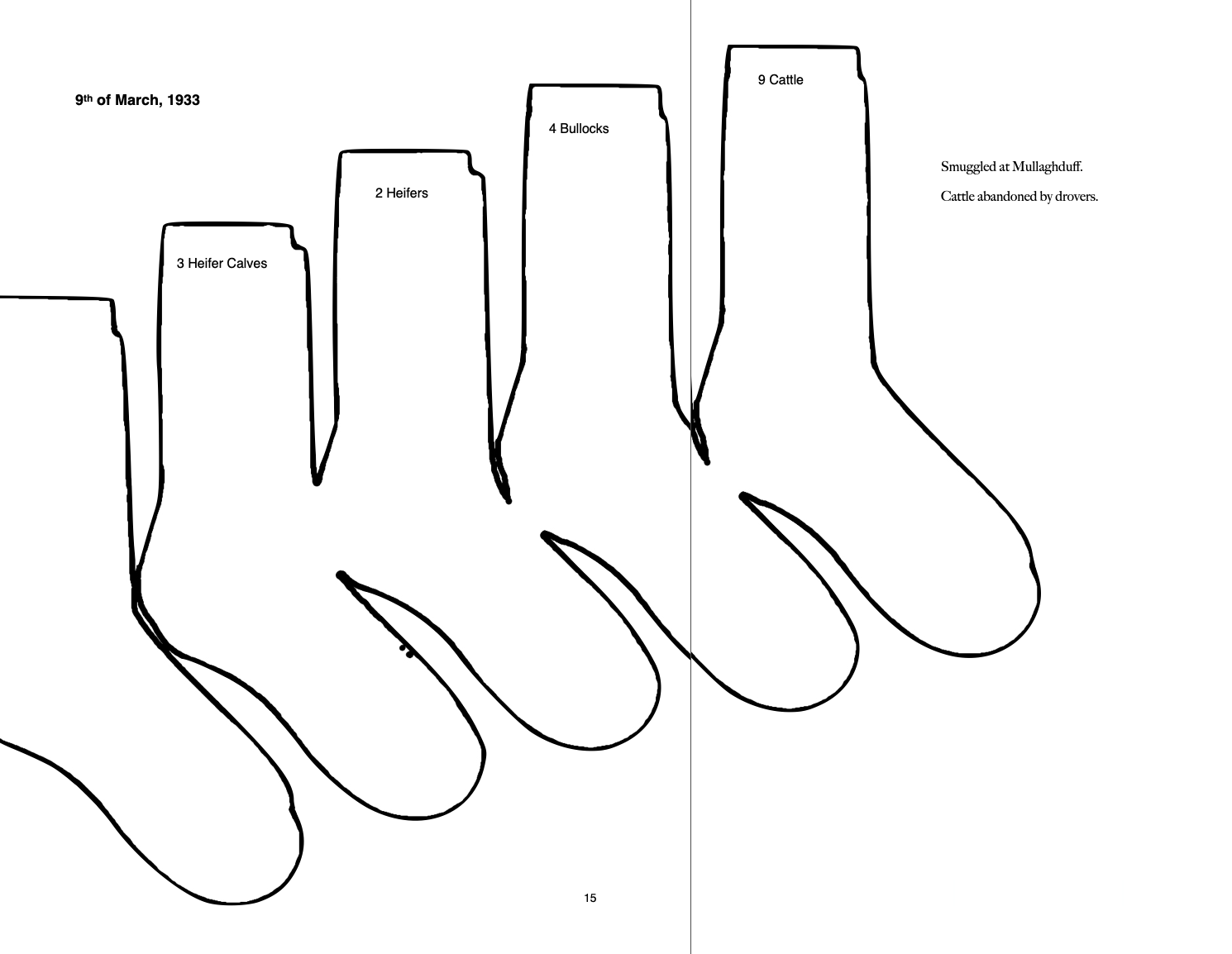
From ‘Particulars of Goods Found in Suspicious Circumstance’, 2026©️