Research note 9 : The Photographs Hatch a plan
For as long as I have had an iPhone—and before that, through the many digital and photochemical film cameras I have used—I have taken thousands of photographs.
Often it is not the whole image that interests me, but an element within it: a figure, a tree, a car, a road, waiting to come to life in another image elsewhere.
At the moment of taking the photograph, I may not know what it is that has caught my attention. Something in the scene asks me to press the button, but its meaning is not always contained within the frame as I first encounter it. The part that interests me may need to be removed from its original surroundings and placed beside something else before I begin to understand why I photographed it.
When the notion comes on me to begin creating one of these new worlds, I do not even always know where to start. Why am I drawn to this one thing rather than another? Is it the scale, the colour or the shape? Is there a relationship between two images that I have already sensed without consciously recognising it?
Often I do not know, so I begin by cutting.
It is in the act of cutting out, moving and placing that I sometimes hear what the images are trying to tell me. I try not to impose my own ideas but it’s hard not to. I know it’s better that I don’t take the lead, it works best when the cut-outs themselves do that. That then allows me to think about chance, about intuition and how they can enter the process. One image may suddenly call for another that was photographed many years earlier from an entirely different place.
In the collage ( above), an elderly woman, photographed late one evening in Nice last year, told me to place her on a yellow road. I’d taken that photograph in a woodland in Bath about 5 years previously on one of my Bath rambles.
Did she speak to me in French? I am not sure she did, but however she got the message to me, I carried out her instruction. Once I had placed her there, I realised that she had been asking me to think about Dorothy and the yellow brick road in The Wizard of Oz. But this was Dorothy much later in life: a little fragile-looking perhaps, dressed as though she belonged to another era, because old people don’t always look like old people these days, but not lost and not wandering.
When I first photographed this woman who I now recognise as the older Dorothy, I had been struck by the fact that she was walking alone. It was late, dark even, yet she appeared purposeful.
She was going somewhere.
This way of working is not only about making collages. It is a method I return to throughout my practice: remaining open to chance, intuition and listening, and allowing meaning to arrive through the making rather than deciding everything in advance. It requires me to trust the process, open up,to it and believe in it fully.
The photographs may wait on my phone for years before finding the other images they need to speak to but when they eventually meet, it’s not long before, together, they hatch a plan.
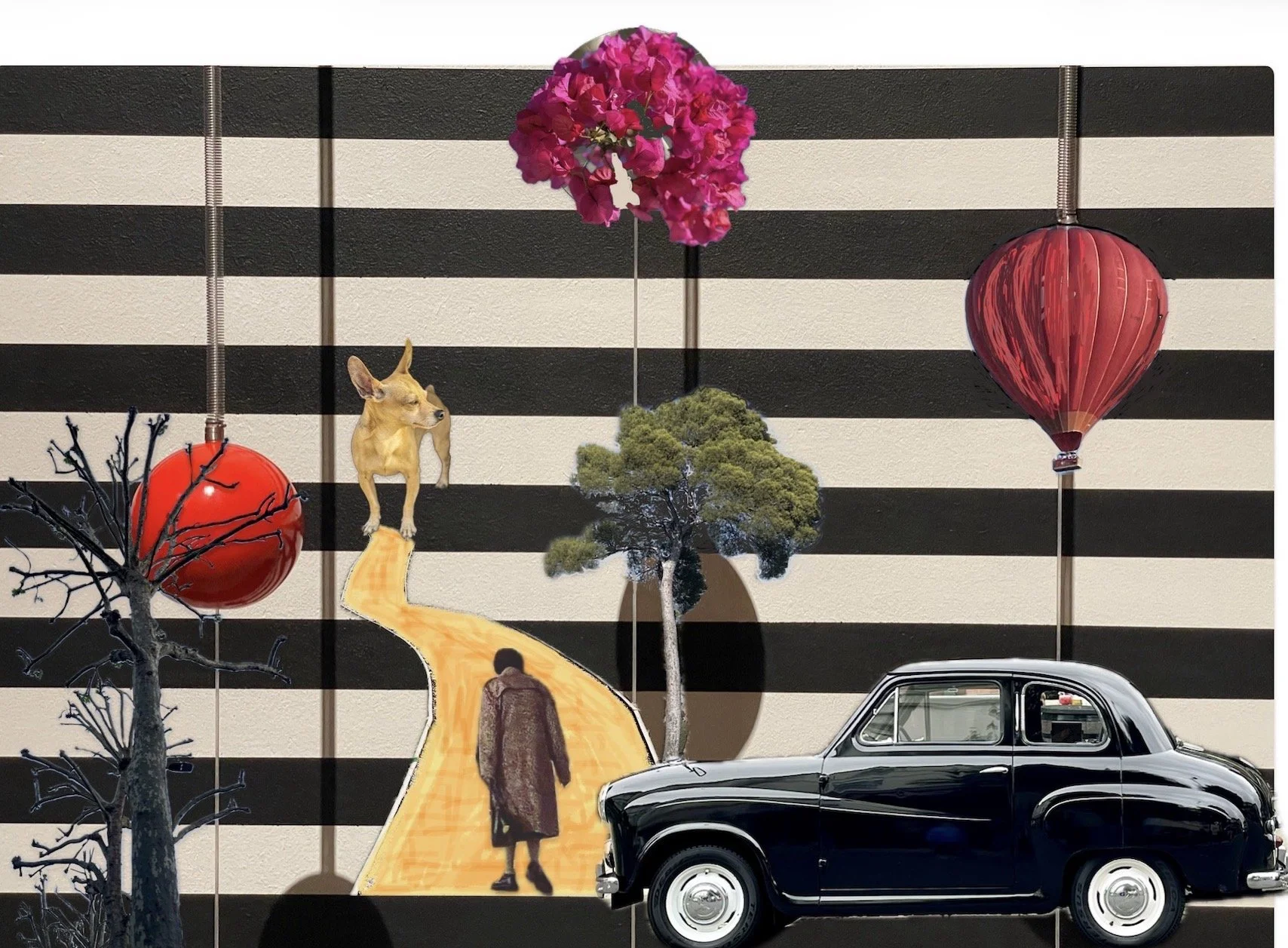
Goodbye Yellow Brick Road (collage, 2026)©️