Research Note 8: A Voice You Can Hold Up to the Light
This week I have been corresponding with the Heritage Officer at Fermanagh and Omagh District Council, who is putting together a programme of talks for the autumn. She has invited me to screen Acts of Memory in Omagh Strule Arts Centre at the end of November.
For those of you who don’t know, Omagh is the county town of Tyrone. I went to school there for seven years, and it lies the same amount of miles from the village where I was born.
I have shown my work in Omagh before, but not often, and I always find the prospect slightly unsettling. The films I make do not sit easily within mainstream forms of cinema, and in advance of showing them there I often find myself imagining the audience: will they understand the work, will they come simply because they know my family, or out of curiosity and/or will they leave disappointed or dissatisfied because the language/form of the films are not one they encounter every day.
And yet I want to show the work there.
I want to share something of the life I have lived while not being there, and of the work I have made elsewhere, in the place that has continued to shape how I look at the world.
The people I knew, the stories I heard and the voices around me as I was growing up have all entered the work in ways that are not always immediately visible.
Perhaps that is why, as I think about returning to Omagh with Acts of Memory, I keep coming back to the narrator and its voice.
A voice.
I wrestled with the idea of using an AI-generated narrator in the film, but in the end the conceit was too good to resist: a voice whose role gradually changes as the story unfolds. What begins as a way of speaking into the gaps left by a damaged and incomplete archive becomes something more uncertain — a voice that starts to question what it knows, how knowledge is produced, and whether it is really in the best position to deliver that knowledge to others.
The film is also concerned with the language of filmmaking itself, and with the rules we are taught to follow when constructing meaning through images and sound. Why this shot and not that one? Whose point of view are we being asked to inhabit? What has been left outside the frame?
The AI voice begins to ask these questions too, becoming increasingly aware that every act of storytelling involves selection. Beneath the subterfuge and the magic of the technology, of course, the voice is really mine.
In that sense, filmmaking and archiving are not so far apart. An archive can never hold everything, just as a film can never show everything. Decisions are always being made about what is kept, what is discarded, what is shown and what remains unseen.
What do I want you to see?
What do I want you not to see?
What do I want you to remember, and what might be allowed to disappear?
Acts of Memory grew out of my residency with the Virtual Record Treasury of Ireland at Trinity College Dublin, a project concerned with reconstructing and refinding material thought to have been lost when centuries of records were destroyed at the Public Record Office of Ireland in 1922.
I shot the film on 16mm, a format introduced the following year, in 1923. I became interested in bringing these different histories together: the loss and rebirth of an archive, the physical life of film, and then, fast-forwarding to 2022, and using a new technology capable of producing a voice without a human speaker.
When the film was finished, I insisted that the digital version I had edited be transferred back onto celluloid as a 16mm print. In doing so, the AI voice became part of the optical soundtrack running along the edge of the film strip.
Holding that strip of celluloid in your hand and up to the light, the voice can be seen.
It appears as a pattern beside the images, indistinguishable from the trace of a human voice. Nothing in its shape reveals that it was generated by a machine.
The waveform is real, although the voice, in a sense, is not.
And once the voice has taken on this physical form, it becomes vulnerable.
Each time the film passes through a projector it changes ever so slightly. It gathers scratches, dust, hair and marks from handling. Over time, the soundtrack will change too, stretching or warping with heat and wear.
The voice will not remain exactly as it was.
Once embedded in a physical substrate, the AI voice begins to share the fate of the archive the film is concerned with. It becomes subject to time, damage, alteration and, eventually perhaps, disappearance.
That is one reason I like Acts of Memory to be shown on 16mm whenever possible. Each projection adds another small trace to its history.
The voice begins without a body.
Then it is printed onto film.
It becomes something I can see.
Something I can touch.
A voice I can hold up to the light, until perhaps one day the light finds only scratches and mould to illuminate, and the earth begins to reclaim it.
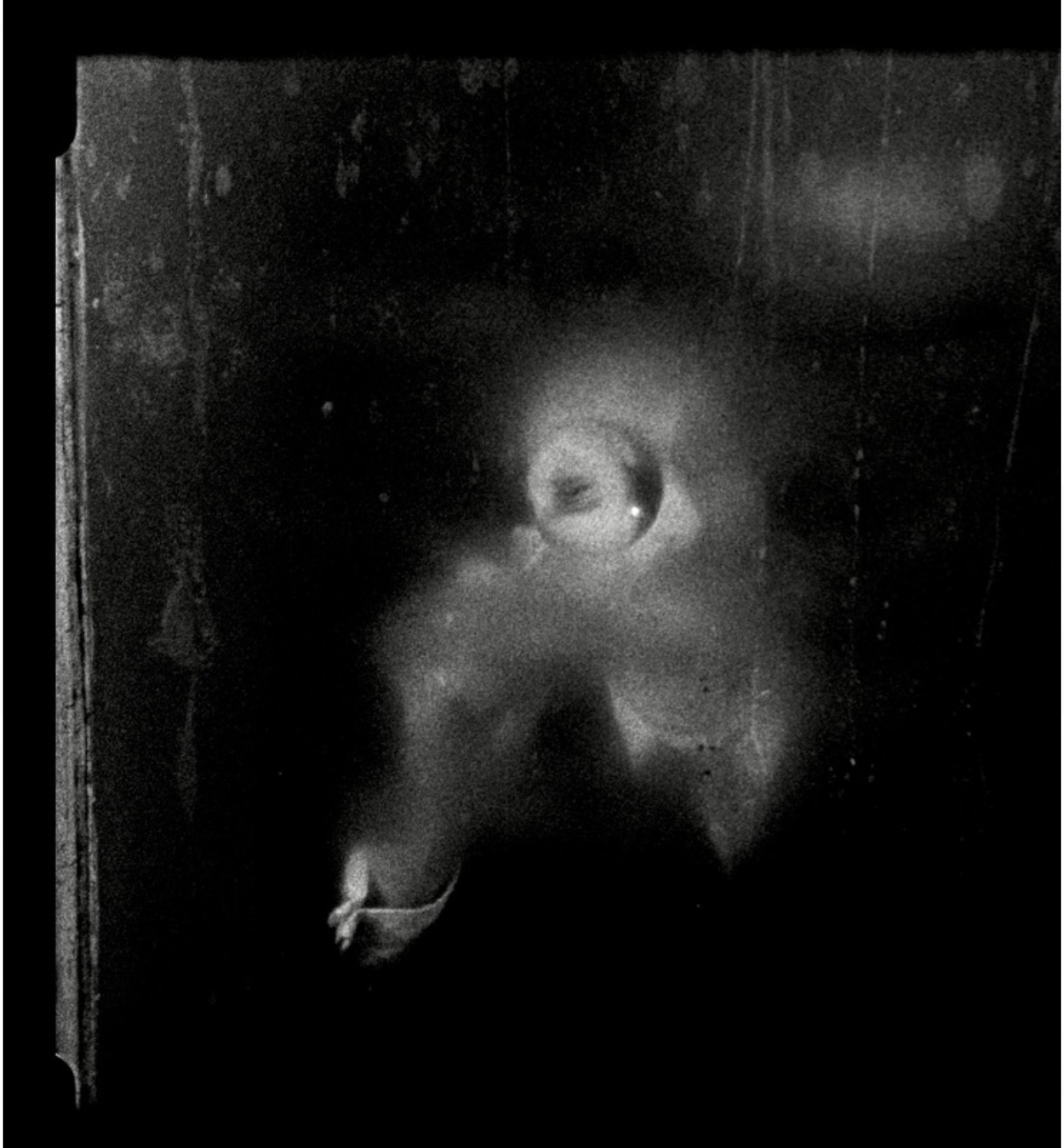
Still from Acts of Memory, 2024, 16mm, 28 mins, MAIRÉAD McCLEAN ©️