
Research Note 13: On the Periphery
I seem to have a habit of talking to strangers.
Recently, while travelling, I found myself in conversation with three people I would otherwise never have met. A young man at an airport lent me his phone charger. A couple I met on the airport bus from the train station in Bristol had missed their flight to Rome and were trying to salvage their holiday. On a flight to Dublin I sat beside a 74-year-old American travelling through Europe on a long-planned list of things he wanted to see and do on his bucket list.
We talked about families, work, ambition, travel, history, music, ageing and the things that make up a life.
Then we went our separate ways.
Reflecting on this I realise I could have remained in my seat, listened to my audiobook, or just got lost in my own thoughts, but instead, something in me wanted to know who these people were.
I think this impulse comes partly from my parents. My father used to say when one of his children was heading off on their travels, “As long as you have tongue in your mouth,” meaning that as long as you can speak, ask for help and communicate with others, you would never be completely stuck. But I think there is something else going on.
I am drawn to people who could easily remain in the background.
I realise I have spent much of my life looking for what wasn't supposed to be the subject. I can see that this impulse was already at play in work I made in 1989, although I didn't have the language for it then.
In 1988 my father travelled to Russia as part of an Irish delegation. I asked him to bring me back Russian posters and postcards, which he did. From these I began making a series of works, including a tape-slide work entitled Russian Postcards while in my last year at Middlesex Poly, BA Fine Art Degree course.
The postcards depicted the monumental figures and symbols of Soviet history: Lenin, Marx, statues, public squares and fountains. These were the official subjects. They occupied the centre of the image and represented a particular version of history and society.
But when I looked closely, I became interested in the people passing through the image.
At first they were almost nothing — tiny printed marks. The postcards were made up of dots of coloured ink, and when enlarged, the people became visible as little fields of red, green and blue overlapping dots. From a distance they disappeared into the image. Up close, they became a person.
I began to enlarge these peripheral figures.
The monument remained monumental, but only partial, it was no longer the only thing I could see.
I became interested in the tension between the great mythologised figure placed at the centre of the image and the tiny people moving around it: the supposedly equal citizens, the people for whom the political system was supposedly being built, each reduced to a handful of printed dots.
What happens when you take something or someone who was never meant to be the subject of the story and make them the subject?
What happens when you give sustained attention to something that could easily have received none?
Perhaps this is what I was beginning to understand in those images.
The official subject is not necessarily the whole story.
The people passing through the background were living their own lives. They had their own histories, desires, disappointments and ambitions. They were not simply extras in somebody else's picture.
It was also a moment of extraordinary historical change. In 1989 the Berlin Wall came down. Glasnost had opened a new space in the Soviet Union and the political world represented by these postcards was beginning to change almost overnight.
Looking back now, I realise that I had started to look away from the monumental subject towards the people living around it.
That impulse has stayed with me.
It appears in found photographs, archival documents and objects whose significance is not immediately apparent. I am interested in what happens when we change the hierarchy of attention; when something at the edge of an image, an archive or a story is brought forward.
I am not the first artist, writer or filmmaker to work in this territory. But I have arrived here through my own particular history, and that changes what I see.
Perhaps this is why I continue to talk to strangers.
For a few minutes, they stop being background.
They become particular.
And I become interested in what might be revealed when we look again at the things, people and stories that were never supposed to be the subject.
On the Periphery
Research Note
Picturing the Border: 1921–2026
Highlanes Gallery, Drogheda
22 August – 30 October 2026
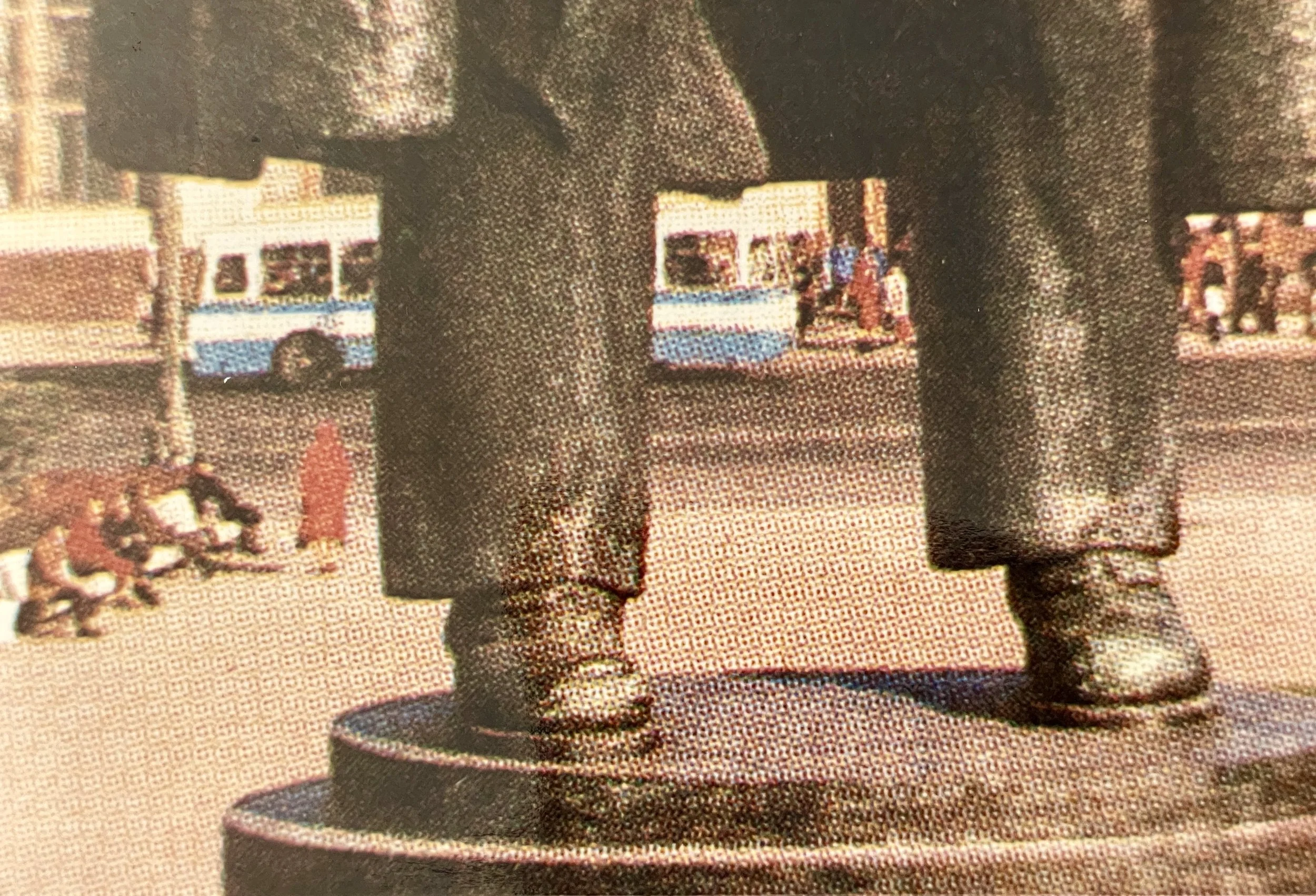
Russian Postcard Series, 1988