Research Note 12: Take the Photograph
Take the Photograph
Photography has been an important part of what I do for a long time. I knew I wanted an SLR camera while studying A Level Art, so that summer I worked in a hotel in London with my sister and saved enough money to buy one. I’ll write more about that another time.
Since then I have taken a lot of photographs. These days I use my iPhone to take them while out walking in the evenings around Bath, often taking routes slightly off the beaten track.
It is usually in places that I’m not overly familiar with that I notice things.
Things on the ground. Things that have been dropped, discarded, misplaced or simply ended up somewhere for a while.
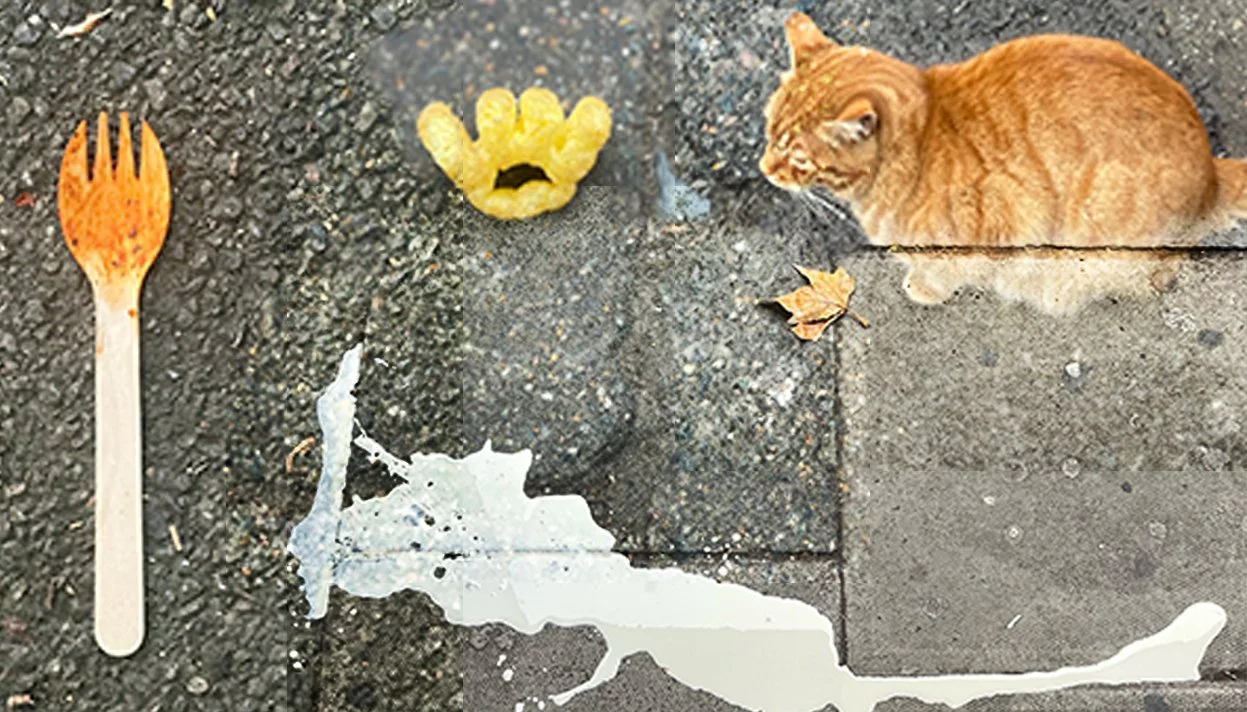
A wooden fork with orange sauce still staining the prongs was lying on the pavement near a bin in the park last night.
Who was the saucy devil eating with that?
When I got back to my flat, the image set me off looking for other similar photographs taken over the years. I found a piece of Monster Munch that looks like a tiny hand — but its a monsters paw — taken several years ago. A ginger cat near a butcher’s shop in Istanbul at the beginning of this year appeared, and then a white spill across the pavement, photographed in London, with a ginger leaf blown in beside it.
These photographs seemed to be drawn together and, as I placed them beside one another, the connections started to flow.
The fork becomes a signifier. The paw brings me to the cat. The cat seems to bring these three together because of the colour . Then the leaf joins them. And once the white spill enters the sequence, another phrase arrives almost automatically:
The cat that got the cream.
The piece could even be called that.
Looking at these images, I also find myself imagining movement around them.
What happened just before the photograph was taken? Who dropped the Monster Munch? A child? What was being eaten from the wooden fork to leave that orange stain? What caused the white spill across the pavement?
The action is missing, but I begin to construct it in my head.
Perhaps this is where the still photograph starts to behave like film for me. One image placed beside another begins to alter what I think I am seeing. The ginger fork sits beside the ginger cat, the cat beside the white spill, and suddenly the cat that got the cream appears. The connection is not contained in any one image. It is made in the space between them.
It makes me think of the Kuleshov effect: the way the meaning of an image can change according to the image placed before or after it.¹
Then the association breaks, and I’m thinking about hair.
In my family we all had varying degrees of ginger hair. At primary school some of the children would call us “gingersnap biscuits”. I don’t remember it feeling particularly nasty. Everyone seemed to be called something.
My parents would get us to repeat:
Sticks and stones will break my bones, but names will never hurt me.
I wonder what happened to that idea?
This is what happens when I look at photographs. One thing leads to another. A fork becomes a colour, the colour becomes a cat, the cat becomes cream, the leaf becomes hair, and suddenly I am back in a primary school playground in County Tyrone and a story around a phrase has formed.
Do the photographs contain any of that?
Probably not.
I put it there.
Or perhaps they simply give my mind somewhere to go.
I sometimes wonder if this is why I photograph these things in the first place. Do I make little dramas from them afterwards, or do I already sense something in them when I stop?
I don’t know.
What I do know is that I remember quite clearly when I began to take this kind of noticing seriously.
Not long after I gave up my full-time teaching job in London in 2012, I was out walking when something caught my eye. I can no longer remember what it was, but I remember the instruction I gave myself.
Take the photograph. Don’t walk on by.
You don’t need to know why.
Something has caught your attention, and that is enough.
Fourteen years and thousands of photographs later, I am still doing it.
Stopping because something on the ground, in a window, beside a wall or at the edge of the road sparks a thought, a feeling or a memory.
Sometimes it reveals itself later.
Sometimes it doesn’t.
Either way, I take the photograph.
¹ Lev Kuleshov was an early Soviet filmmaker and theorist whose experiments with montage demonstrated how the meaning of one image can shift depending on the image placed beside it.
The Cat That Got the Cream, 2026©️