Research Note 4 : The Red Man's Tooth
Some images stay with me because they change while I am looking at them.
A few years ago, during my Decade of Century Artist in Residence with The Virtual Record Treasury of Ireland, I was looking closely at an Ordnance Survey map of Portrush from 1899, drawn to the fine lines that describe height, depth, coast and sea. The contour lines seemed to wrap around the land like waves, or like breath. I found myself listening to them as much as looking at them.
Then the coastline began to appear as something else: In front of my eyes I saw a tooth, roots and all.
Once I saw it, I could not unsee it. The map was still a map, but it had also become a body. Portrush became enamel, nerve, gum, pain.
I knew that the Giant’s Causeway was nearby, and this brought back a childhood story of Finn McCool and the Scottish giant, the Red Man. In the version I remember, Finn’s wife gives the giant an oatcake so hard it breaks his teeth. Terrified by what this suggests about Finn, he runs back across the sea to Scotland.
And with that, on the map on the screen in front of me, the headland became one of the Red Man’s lost teeth!
I printed a close up copy of that part of the map and coloured the area of coastline red: a bloodied tooth, a pulsing tooth, a tooth full of story. The red does not explain the map; it lets another image rise through it.
I’m beginning to realise that this is how the contents of an archive sometimes work for me. A factual document opens into memory. A surveyed coastline slips into myth. A childhood story returns through the shape of a place. The past does not stay behind me. It catches, flares, and appears again in the present as something else and I’m moved to bring it forward.
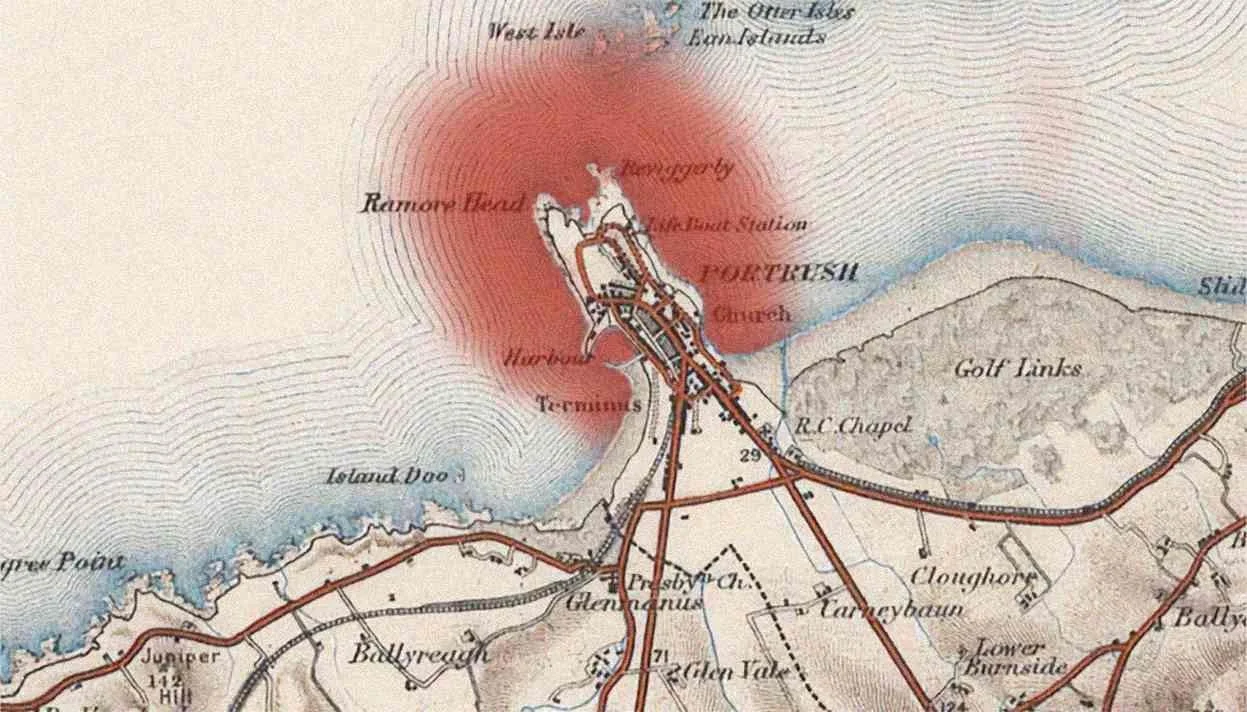
The Red Man’s Tooth, 2024©️