
Research Note 6: Golden Delicious
It is an odd name for an apple. A little seductive perhaps. Sweet, desirable, almost cinematic.
With this week's hot weather and some apples already hanging on the trees around Bath, I found myself thinking back to this time last summer when I was making a short 16mm film with the same title.
The film began in the Polish Archive of Home Films (see link below).
I had been invited by The Wapping Project and the Museum of Modern Art in Warsaw to make a series of five short films using some of the amateur archive footage held there. The commission eventually became Breath Memory (Pamięć Oddechu), but at the beginning I had no clear idea what I was looking for. I simply spent hours searching through fragments of other people's lives, waiting for a piece of film to hold my attention, to speak to me.
And then I found him.
A man standing in an orchard.
He bends down, picks up apples from the ground, bites into them and throws them away. His actions, and perhaps more importantly his gaze, catch my attention and I make a note of the reel number. Later, when I mention the footage to someone else, they suggest that he may have been an apple taster in an orchard, checking the fruit before it was harvested.
I return to the reel.
This time I notice that he is often looking directly towards the person behind the camera. At one point he throws a bitten apple in their direction. There is something playful in the exchange and I find myself imagining that the camera operator is a woman. There is nothing in the footage to confirm this, but I feel it. Whether that is true or not hardly matters. What matters is that the relationship feels real enough for me to open a dialogue.
And for a moment he looks straight at me.
Once that thought arrives there is no turning back. The filmmaking has already begun.
Between domestic chores and family life I find time to take an apple to a park in London where a small orchard grows. I ask my partner and his son to film me on their iPhones as I begin playfully to reply to the Polish man's gestures. Together we work out where I need to stand in relation to the camera, where the thrown apple should fall, which hand should catch it, which arm should throw it back.
Later I re-film the digital footage onto 16mm colour film. It feels right that my reply shares something of the physical language of the original home movie. Grain, flicker, dust, instability—the material matters. I need the two pieces of footage to meet on common ground.
While editing I slow things down even further. Individual frames become still photographs. Those stills are reanimated, allowing time to stretch, fold and ghost back into itself. The conversation becomes less about movement than about attention. A look, a gap, a gesture returned.
While the apple remains an ordinary piece of fruit, it also becomes something else: a small carrier travelling between two different moments in time. His apple passes towards me. Mine returns towards him. He bites. I bite. Somewhere in the edit the exchange becomes believable.
Perhaps that is why the story of Adam and Eve comes to mind. For centuries the apple has been understood as the forbidden fruit: knowledge, desire and temptation. Yet when I looked more closely, I discovered that the Bible never actually says the fruit was an apple.
From what I read the apple appears much later, helped along by a curious coincidence in language. In Latin, malum can mean "evil", while mālum means "apple". Artists embraced the wordplay and, over centuries, the apple became fixed in the Western imagination as the fruit of the Fall.
I find this fascinating.
A coincidence becomes an image. The image is repeated. Repetition becomes convention and eventually, convention begins to feel like truth.
Perhaps this is where Golden Delicious comes back in.
The film itself begins with a coincidence. Out of hours of other people's lives, I happen upon this particular man in this particular orchard. He happens to look towards the camera. He happens to throw an apple towards it. I happen to be there, decades later, looking back.
From these coincidences I construct a conversation.
There is something exciting to me in the possibility that what we accept as fixed may not be fixed at all. History is full of stories, images and interpretations repeated so often that they acquire the authority of fact. But if we look closely enough, sometimes something shifts. A gap appears. Another possibility opens.
Perhaps an archive allows this too.
We can return to an image and look again.
Sometimes I become ridiculously excited by this idea. I imagine that Golden Delicious contains the answer to a question that quantum physics has not yet thought to ask. Perhaps time itself is another thing we have learned to understand in a particular way: past behind us, future ahead, each moment disappearing as the next one arrives.
But what if, for three minutes at least, a film can propose something else?
A man throws an apple in Poland decades ago.
I catch it in London.
I throw it back.
Then, as they say in Ireland, I 'catch myself on'.
Perhaps this film contains nothing more than a fleeting flirtation with a man I never knew, a man who is probably no longer alive, a man who caught my eye while I was searching the archive for someone to talk to.
And yet, somehow, he replied.
I did not make Golden Delicious with Swedenborg in mind. That connection only occurred to me later, after the film was screened at the Swedenborg Society in London. Looking back, I recognised an affinity with Swedenborg's idea of correspondences: that ordinary things might carry meanings beyond themselves, and that the material world can become a place where separate realities briefly touch.
This is often how ideas arrive in my work. I rarely make something as a direct response to something I have read. The reading may already be there somewhere, absorbed without my fully recognising it, but it is often only afterwards that I begin to understand the connections.
The work seems to know something before I do.
Looking back now, I wonder whether Breath Memory (Pamięć Oddechu) has been exploring this all along.
Not memory as something preserved.
But memory as something still capable of reply.
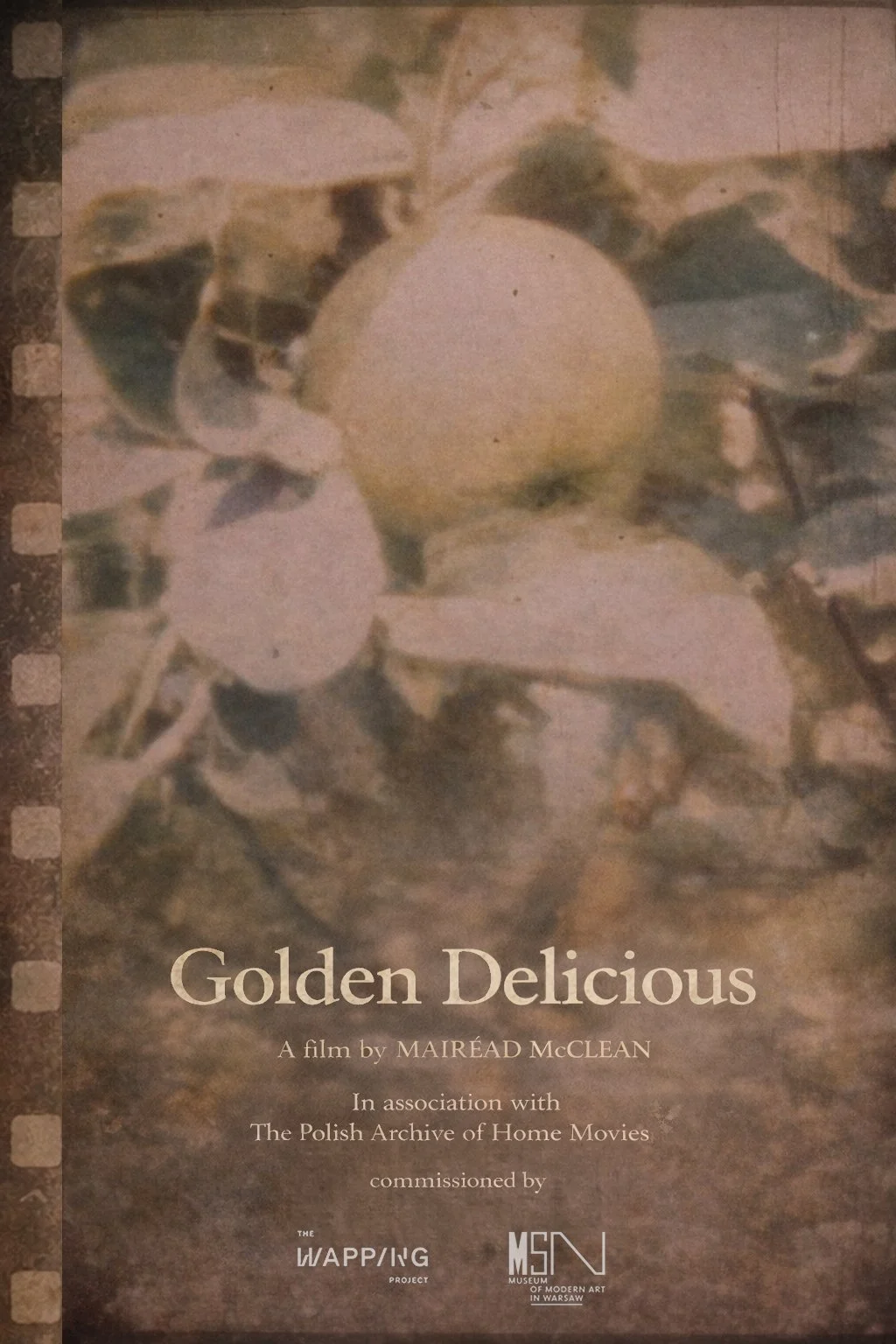
Golden Delicious Poster, 2025©️